Unlocking Early Literacy: The Ultimate Guide to the Printable Alphabet K Mini Book and 7-Activity Workbook
In the journey of early childhood education, few milestones are as pivotal as mastering the alphabet. While many parents and educators focus on memorizing letters in order, true literacy begins with understanding the unique sounds, shapes, and applications of individual letters. For young learners aged three to six, the letter K presents a fascinating opportunity to bridge the gap between visual recognition and phonemic awareness. This is where the Printable Workbook with 7 Activities and Alphabet K Mini Book becomes an indispensable tool for preschool, pre-K, and kindergarten classrooms.
This comprehensive resource is not merely a collection of pages to be filled; it is a structured learning pathway designed to build strong foundations in phonics, letter formation, and alphabet mastery. By engaging children in playful repetition and visual recognition, this pack transforms the abstract concept of the letter "K" into a tangible, hands-on experience that supports critical pre-reading skills.
Why Focus on the Letter K?
The letter K is often one of the last letters introduced in traditional alphabet songs, yet it holds significant value in early phonics instruction. It represents a hard consonant sound that is distinct from similar-looking letters like C or G, making it an excellent candidate for differentiation exercises. Furthermore, the letter K appears frequently in common words (such as kite, key, kangaroo, and kick), providing ample opportunities for vocabulary building.
However, simply singing about the letter K is rarely enough for young minds to retain the information. Children at the preschool and kindergarten levels are kinesthetic learners who need to touch, move, and create to understand concepts fully. This is why interactive worksheets are superior to passive observation. They allow children to physically manipulate the letter, tracing its curves and straight lines, which reinforces muscle memory essential for future handwriting tasks.
A Deep Dive into the 7 Unique Activities
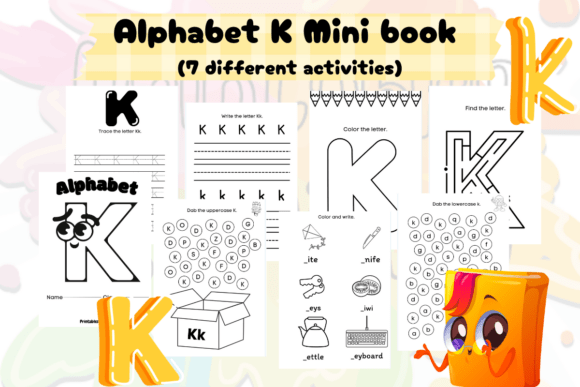
The core of this educational pack lies in its seven carefully curated activities. Each activity targets a specific developmental milestone, ensuring a holistic approach to learning the letter K. Let us explore how each component contributes to a child's overall growth.
1. Tracing Uppercase and Lowercase Kk
The foundation of any writing system is the ability to form letters correctly. The first activity invites children to trace the uppercase K and lowercase k. This exercise is crucial for developing fine motor coordination. By following the dotted lines, children learn the proper stroke order and directionality required for legible handwriting. This step-by-step guidance prevents bad habits, such as starting strokes in the wrong place, before they become ingrained.
2. Structured Handwriting Lines
Once the child has traced the letter, the next logical step is independent practice. The workbook provides structured handwriting lines where learners can write the letter K on their own. This transition from guided tracing to free-form writing builds confidence. It allows educators to assess whether the child understands the spatial relationship between the letter's components—the vertical line and the two diagonal arms.
3. Dotting the Letters for Fine Motor Work
Fine motor skills are not just about holding a pencil; they involve the small muscles in the fingers and hands. The "dot the letter K" activity challenges children to use crayons, markers, or even dot markers to fill in the shape of both uppercase and lowercase Ks. This repetitive motion strengthens the pincer grasp, a skill that is directly transferable to buttoning clothes, using scissors, and eventually writing sentences fluently.
4. The Letter K Maze
Cognitive development goes hand-in-hand with physical development. The Letter K Maze is a delightful challenge where children must navigate a path to find the correct letter K among distractors. This activity enhances problem-solving skills and visual discrimination. It teaches children to filter out irrelevant information and focus on the target shape, a skill that is vital for reading comprehension later in life when distinguishing between similar words.
5. Color and Write
Color is a powerful motivator for young learners. The "Color and Write" section combines artistic expression with literacy practice. By coloring the letter K, children engage their creativity while reinforcing the visual identity of the letter. Following the coloring with writing ensures that the creative impulse transitions smoothly back into academic focus, keeping the child engaged without feeling overwhelmed by dry drills.
6. Phonics Word Identification
Understanding the sound a letter makes is the essence of phonics. This activity focuses on identifying and completing words that start with the letter K. Whether it is connecting a picture of a kitten to the word or filling in the missing first letter of ___at, these exercises solidify the connection between the symbol "K" and the /k/ sound. This phonemic awareness is a predictor of future reading success.
7. Cut and Paste Vocabulary Building
The final activity introduces the element of tactile manipulation through cutting and pasting. Children cut out images and words that begin with K and paste them into the correct category. This not only refines scissor skills but also categorizes vocabulary. It helps children organize their knowledge, understanding that "kite," "king," and "kitchen" all share a common beginning sound and belong to the same linguistic family.
Practical Applications in Modern Education
The versatility of this printable workbook makes it suitable for a wide array of educational settings. In a classroom environment, it serves as an ideal centerpiece for Letter of the Week lesson plans. Teachers can utilize the materials during phonics centers or literacy stations, allowing students to work independently while the teacher facilitates other groups.
For homeschoolers, this resource offers a structured curriculum that requires minimal preparation. It fits seamlessly into morning work routines or serves as an engaging activity for early finishers who have completed their primary assignments. Additionally, it is perfect for back-to-school reviews, helping to refresh a child's knowledge after a long break.
Bridging the Gap Between Play and Learning
One of the most common misconceptions about early childhood education is that play and learning are separate entities. The Alphabet K Mini Book dismantles this barrier. By embedding educational objectives within fun activities like mazes, coloring, and puzzles, the workbook ensures that learning feels like play. This approach aligns with modern pedagogical theories that emphasize engagement and intrinsic motivation.
Furthermore, the resource addresses the needs of diverse learners. Visual learners benefit from the color-coded sections, auditory learners can chant the sounds while working, and kinesthetic learners thrive on the cutting, pasting, and tracing actions. This multi-sensory approach ensures that no child is left behind, regardless of their preferred learning style.
Building a Strong Foundation for the Future
The ultimate goal of using this workbook extends beyond knowing the letter K. It is about fostering a love for language and building the confidence necessary to tackle more complex academic challenges. When a child successfully completes a page, recognizing the letter K, forming it correctly, and associating it with real-world words, they experience a sense of accomplishment. This positive reinforcement is critical for developing a growth mindset.
By reinforcing uppercase and lowercase recognition, developing phonemic awareness, and enhancing fine motor coordination, this pack supports the pre-reading skills that are the bedrock of literacy. As children progress through these seven activities, they are not just learning an alphabet; they are learning how to think, observe, and communicate.
In conclusion, the Printable Workbook with 7 Activities and Alphabet K Mini Book is more than just a set of worksheets. It is a comprehensive toolkit designed to ignite curiosity and solidify foundational skills. Whether used in a bustling classroom or a quiet home study corner, it provides the structure and fun necessary to make the letter K—and the entire alphabet—a memorable part of a child's early development.